
The short version
- When the Board hiked on 29 September, the latest monthly CPI it had was July’s. August’s figure (4.0%) was published the next day, 30 September.
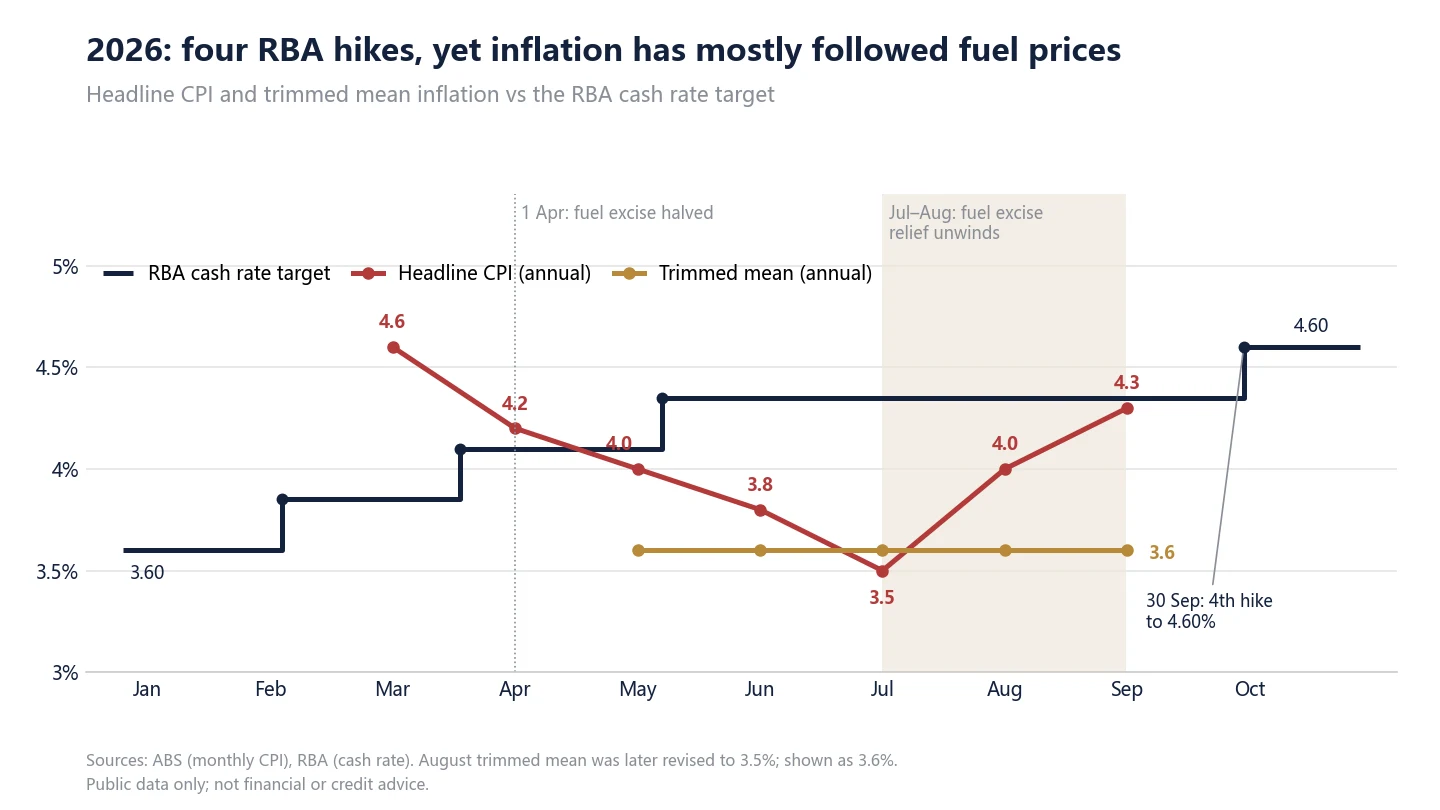
- Headline inflation in 2026 has mostly followed fuel prices. It eased after the fuel excise was halved on 1 April, then rose as the relief was unwound in July and August. Fuel and electricity are excluded from the RBA’s preferred “trimmed mean” measure.
- Trimmed mean inflation has sat around 3.6% from May to September. After four hikes it has neither fallen clearly nor accelerated.
- The RBA itself says policy takes one to two years to have its full effect, and that part of the persistence in inflation comes from factors beyond monetary policy. That is exactly why “should it keep hiking?” is a fair question.
Note: this article keeps official data and our own view apart. Section four is opinion. It is not fact and not a forecast of where rates go.
1. What has happened in 2026 so far
Cash rate target (RBA):
- 2025: a run of cuts, down to 3.60% by August.
- 4 Feb 2026: raised to 3.85%
- 18 Mar 2026: raised to 4.10%
- 6 May 2026: raised to 4.35%
- 11 Aug: held
- 30 Sep 2026 (decided 29 Sep): raised to 4.60%, the fourth increase this year
Headline CPI (ABS, annual): Mar 4.6% → Apr 4.2% → May 4.0% → Jun 3.8% → Jul 3.5% → Aug 4.0% → Sep 4.3%.
Trimmed mean (ABS): about 3.6% from May to September (August was later revised to 3.5% after a seasonal-factor change).
2. What data did the Board have on 29 September?
The Board’s minutes, published two weeks after the meeting, list what it saw:
- July monthly CPI: stronger than expected, particularly for market services.
- Fuel: petrol and diesel prices in August were about 13% above forecast.
- Breadth of price rises: the share of items rising by more than 2.5% was “well above average.”
- Labour market: unemployment rose to 4.6% in August; unit labour cost growth was above what is consistent with target inflation, with weak productivity.
- Activity: June-quarter GDP was slightly stronger than expected and business investment was up more than 10% over the year; household consumption was below trend.
- Housing: prices fell faster than expected; scheduled mortgage payments were around 10% of household disposable income.
- Market pricing: a hike was already expected.
So “the RBA relied on August data” is not quite right: it had CPI up to July, plus August jobs data and more. But the point behind it is real: monthly CPI arrives about four weeks after the month ends, so the Board is always looking backwards. August CPI (4.0%) came out on 30 September and September CPI (4.3%) on 28 October. The latter will be the freshest reading before the next meeting (reported to be 3 November).
3. How much of inflation can a rate rise reach?
ABS data for September:
- Headline inflation 4.3% (August: 4.0%); trimmed mean 3.6%.
- Housing rose 5.2%, the largest contributor, driven by new dwelling prices (up 4.7%) and electricity.
- Transport rose 8.7%, driven by petrol. Fuel was up 9.4% in September after a 14.8% jump in August.
- Fuel and electricity are excluded from trimmed mean, which is the main reason headline and underlying inflation differ.
What the RBA says:
- Its August statement said the oil supply disruption is adding directly to inflation and higher fuel costs are passing through to other goods and services.
- In the minutes, Board members accepted that part of the medium-term persistence in inflation may be driven by “factors beyond the influence of monetary policy.”
- The RBA’s own explainer says policy can take “between one and two years” to have its maximum effect.
In other words: the oil price is set in global markets and the cash rate cannot change it, and on the RBA’s own estimate, the effect of the February to May hikes has not fully come through yet.
The Board’s case also has data behind it. In the minutes, staff judged the July upside surprise more likely to reflect domestic capacity pressure than cost pass-through from the Middle East, unit labour costs are high, and price rises are broad.
4. Our view: which questions deserve another look
These are observations from us as mortgage brokers. They are not the RBA’s position and not a prediction of future rates.
1. The data is lagged and the policy effect is lagged even more. Data runs one to two months behind; policy effects run one to two years behind. The cash rate is already up a full percentage point this year, and the latest rise has barely started to work. With house prices falling, unemployment at 4.6% and consumption below trend, the “hold” arguments recorded in the minutes carry real weight.
2. Rate rises have limited reach over supply shocks such as fuel. The ups and downs in headline inflation this year line up closely with the fuel excise and oil price. Trimmed mean has stayed near 3.6%. If the upside is mostly oil, further hikes mainly suppress domestic demand, not the oil price.
3. Look at the trend, not one month. The 4.0% and 4.3% prints are headline numbers amplified by fuel. Trimmed mean did not accelerate over the same period. Reading headline alone can mislead.
The RBA’s reasoning deserves a fair statement too. Inflation has been above the 2–3% target band for a long time, and if expectations drift up the cost of bringing it back is higher. Domestic capacity pressure and wage costs are real. “Wait and see” and “act early” are both defensible, and what happens next depends on data nobody can guarantee.
5. What this means for borrowers
- Roughly, on a $1 million loan each 1 percentage point change in rate moves annual interest by about $10,000. Four hikes total one percentage point, which variable-rate borrowers will already see in their repayments.
- Lenders assess borrowing capacity at your rate plus a 3-percentage-point buffer, so higher rates hit both repayments and how much you can borrow. See our reading of 2026 Sydney mortgage rates.
- Construction, commercial and SMSF loans are often variable or reprice with the market and can be more sensitive to rate moves. If you are planning in these areas, build a higher-rate scenario into your budget.
- Rather than betting on direction, it is more practical to check whether your current rate is still competitive, whether cash flow can handle somewhat higher rates, and whether fixing part of the loan makes sense.
To see how your own loan looks at different rates, book a free consultation.
Sources (all public): RBA statement, 29 September 2026, RBA statement, 11 August 2026, RBA minutes, September meeting, RBA cash rate history, RBA: transmission of monetary policy, ABS: CPI, September 2026, ABS: CPI, August 2026.
This article is general information and personal opinion only. It is not personal financial, investment or credit advice. Data comes from the public sources above, as at 29 October 2026, and may be updated or revised. Interest rates cannot be predicted; rely on the latest RBA and ABS releases.
← Back to Insights